
All roads will eventually exhibit wear and tear, cracks, potholes, and other surface corrosion that undermine the quality of infrastructure and road safety. To municipalities, contractors, and property owners, it is important to have a quick, dependable, and cost-effective solution to repair. Cold asphalt patching mix has been one of the most viable innovations in road maintenance of the modern day. It needs neither heating equipment nor skilled labour, nor can it be applied in a wide range of weather conditions, as opposed to the traditional hot-mix asphalt. Here, we discuss all you need to know about this material, including its composition and its applications in the real world.
What Is Cold Asphalt Patching Mix?
Cold asphalt patching mix is a ready-to-use road patching mix that is composed of aggregates and bituminous binders and is designed to be worked at ambient temperature; no heating is needed. It has been specifically designed to be used in maintenance work and can repair potholes, cracks, and surface damage on roads, driveways, parking lots, and other paved surfaces very quickly.
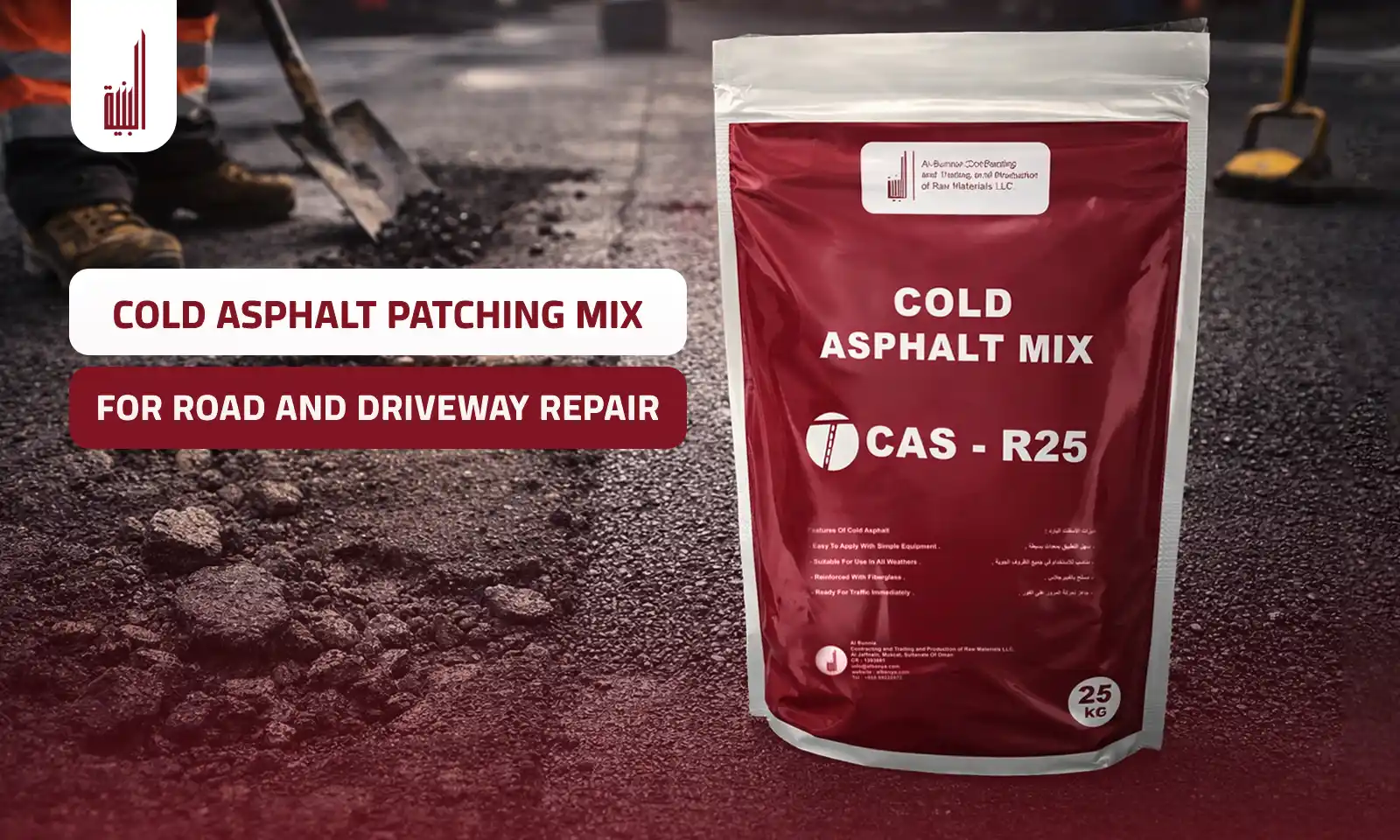
The example of the CAS-R25 product in Alberta has 25 kg bags that are ready to use with a shelf life of 18 months. The area of each bag is about 45 cm x 45 cm x 5 cm deep, which allows one to easily estimate the amount of material required to do any repair.
Key Benefits of Using Cold Asphalt for Repairs
Using a cold asphalt patching mix delivers a wide range of operational and economic advantages:
- Ease of use: No special training or equipment needed; it can be used with simple hand tools by workers.
- Immediate trafficability: Roads may be reopened to traffic a short time following compaction.
- Green: Made using environmentally conscious materials; does not need open flames on location.
- Fibreglass reinforcement: There are formulations that are reinforced with fibreglass, such as CAS-R25, that have improved structural performance.
- Traffic flow not affected: Minimal lane closures with small-scale repairs.
- Convenient transportation: Sent in convenient 25 kg boxes, making them simple to store and transport.
- Long shelf life: The shelf life can be as long as 18 months, provided it is stored properly, making it less wasteful.
When Should You Use Cold Asphalt Patching Mix?
The life of the repair may be determined by the time of the application of the cold asphalt patching mix. The following are the best-case scenarios:
- Emergency pothole fixes: When an unsafe pothole is formed and should be filled in a few hours, not days.
- Winter maintenance: When the hot asphalt is not feasible because of the temperatures or because the hot plant is out of operation.
- Stations that are far or inaccessible: a place where heavy machinery cannot be carried.
- Temporary to permanent repairs. These are represented by cold mix, which can be either a temporary fix or a permanent patch, which can be of long duration when appropriately applied.
- Utility cut reinstatement: Cold mix is used to restore the surface after excavation of underground utility work.
How Cold Asphalt Performs in Different Weather Conditions
| Weather Condition | Suitability | Notes |
| Hot & Dry (>25°C) | Excellent | Optimal performance zone |
| Warm & Moderate (10–25°C) | Very Good | Standard conditions |
| Cold (0–10°C) | Good | Allow more curing time before heavy traffic |
| Wet / After Rain | Good | Remove standing water first |
Research confirms that cold mix patching can be performed across a temperature range of approximately 0°F to 100°F (-18°C to 38°C), making it a year-round solution where hot mix cannot be used at all.
Common Applications for Pothole Repairs
The diversity of cold asphalt patching mixes is applicable to a large number of surfaces and types of repair.
- City street repairs: City maintenance personnel use it to fill in potholes quickly on city streets.
- Driveway restoration is a technique to fix the cracks in personal driveways by homeowners and property managers.
- Parking lot care: Commercial properties depend on them as a way of avoiding liability due to surface hazards.
- Airport taxiway and apron repair: Light surface repair work in the regions that need a minimum disturbance.
- In factories and warehouses, industrial facility roads: Internal roads in factories and warehouses take advantage of fast-cure patching.
- Rural road maintenance: Remote roads that cannot be served with hot mix.
Cost-Effective Road Maintenance Solutions
The first consideration is always on budget when managing infrastructure, both in the public and private sectors. Patching mix, cold asphalt: can save as much as
- There is no plant cost: asphalt plant set up or minimum-order requirements are not required as is the case with hot mix.
- Lower labour expenses: Fewer crew members will be capable of repairing the aircraft more quickly.
- Reduced traffic management expenses: Rapid repairs equate to reduced lane closures.
- Lower equipment costs: Minimal compaction equipment is required; no tankers or pavers are required.
- Long shelf life means less wastage: 18 months of storage means that it can be bought in large quantities without fear of wastage.
The step-by-step instructions for the application of cold asphalt.
When cold asphalt patching mix is applied properly, it will be the most durable. Follow these steps:
- Clean the repair site: clean the pothole or crack of all loose debris, water, and vegetation.
- Bend the edges: Round the ragged edges with a saw or chisel to fit the glue wherever you can.
- Add a tack coat (not necessary, but advisable): A coating of bitumen emulsion enhances bonding.
- Add the cold mix: Fill the area in layers up to 5 cm deep.
- Compact, well-mixed up-compress with a plate compactor, tamper, or vehicle tyre.
- Check level and top up: add additional material when the surface is lower than grade following compaction.
- Open to traffic: The field can usually be used as soon as it has been compacted.
Advantages Over Traditional Repair Methods
| Feature | Cold Asphalt Patching Mix | Hot Mix Asphalt | Concrete Patching |
| Heating Required | No | Yes (150–180°C) | No |
| Traffic Return | Immediate | After cooling | 24–48 hours |
| Weather Flexibility | High | Low | Moderate |
| Shelf Life | 18 months (bagged) | None | Short once mixed |
| Bond to Existing Asphalt | Excellent | Excellent | Poor |
Tips to Ensure Long-Lasting Results
To maximise the service life of your cold asphalt repair:
- Never skip cleaning: Dirt and water are the #1 cause of premature repair failure.
- Compact in layers: For repairs deeper than 5 cm, apply and compact in multiple 5 cm lifts.
- Overfill slightly: Account for compaction settling by adding 10–15% more material than the void appears to need.
- Store bags properly: Keep unused product in a cool, dry location, sealed tightly to preserve shelf life.
- Use fibreglass-reinforced products: Products armed with fibreglass, like CAS–R25, offer superior resistance to cracking and load stress.
- Seal cracks around the patch: Prevent water infiltration to extend its life.
Get Premium Cold Asphalt Patching Mix from Albenya Today
If you’re looking for a proven, professional-grade cold asphalt patching mix, Albenya offers industry-leading solutions trusted by contractors and municipalities across Oman, Saudi Arabia, Kuwait, Iraq, Yemen, and Qatar. Their CAS–R25 product is:
- Ready to use straight from the bag
- Reinforced with fibreglass for superior strength
- Environmentally friendly
- Backed by an 18-month shelf life
- Available in convenient 25 kg bags
Contact Albenya today via WhatsApp or their website to request a quote, find a distributor near you, or become a distribution partner.
FAQS
What is cold asphalt patching mix made of?
It is a pre-blended mixture of mineral aggregates and bituminous binders (asphalt emulsion or cutback asphalt) formulated to remain workable at room temperature. Some premium products include fibreglass reinforcement for added strength.
How long does a cold asphalt repair last?
When properly applied and compacted, a cold asphalt patch can last several years. Longevity depends on surface preparation quality, traffic load, and drainage conditions.
Leave A Comment