
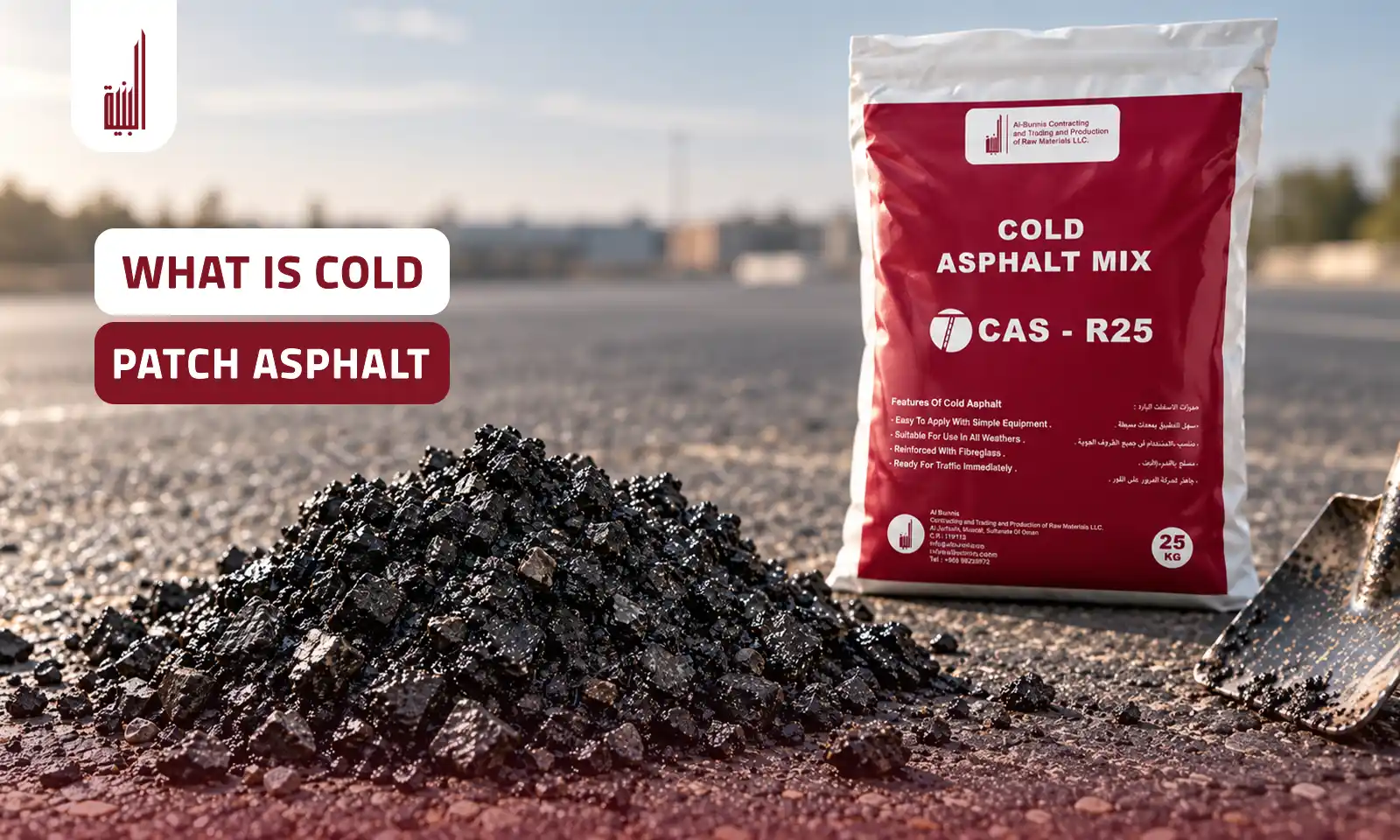
Road damage can take place rapidly, caused by traffic, rain, temperature, and general deterioration of the pavement. If potholes are discovered, repairs should be made as soon as possible to minimize additional damage to the road’s surface and ensure safe travel. However, conventional asphalt repairs can require the use of heating equipment, extra preparation, and careful scheduling. When you’re investigating what cold patch asphalt is, this material can be a practical solution for a number of localized road maintenance applications. It’s an asphalt blend that can be used on site without a heat source, and as such should prove useful to contractors, maintenance crews and property managers.
What Is Cold Patch Asphalt
To understand what cold patch asphalt is, it helps to look at how it differs from conventional hot mix asphalt. Cold patch asphalt is a ready-to-use mixture of aggregate and bituminous binder formulated for localized pavement repairs. Depending on the product, additives may be included to support workability, storage, and application.
Cold patch material is not heated at the repair site like hot mix asphalt. It is convenient to fill potholes, repair selected damaged sections and to perform maintenance when heating equipment is not available or impractical.
Cold asphalt is typically packaged in bags, which makes it easy for maintenance crews to carry small amounts of asphalt to various repair sites. The material may be beneficial for access roads, parking areas, residential roads, or other areas where patching is reasonable.
The performance will vary, however, according to the product formulation, pavement condition, traffic loads, surface preparation, and compaction. Always follow the manufacturer’s instructions and do not presume that all cold asphalt products work for all repairs.
What Is Cold Patch Asphalt Made Of?
There are differences between the composition of cold asphalt from one manufacturer to another and difference in the specifications. In general, the mixture consists of mineral aggregates, a bituminous binder and any additives that are necessary to the formulation for the specific application.
Main components are:
- Mineral aggregates: These consist of sand, crushed stone or other graded material that provides the structure and load-bearing capabilities of the mixture.
- Bituminous binder: Asphalt binder is used to bind the aggregate particles together and to give the mixture cohesion.
- Formulation additives: Additives are used to help keep the product from getting too stiff while in storage, or to aid in applying the product under certain conditions.
The grading of the aggregate and the type of binder used will affect aggregate placement and compaction. The same properties also impact its appropriateness for different repair situations.
The buyer should consult the technical data sheet when considering what the cold patch asphalt is made from, instead of checking the general ingredient list. Product documentation may contain details regarding the applications, storage, what sort of repairs are suitable, or any restrictions in use.
Also, the material must be compatible with the existing pavement condition. The repair methods can be different for a shallow surface defect vs. a deep pothole with unstable underlying layers.
When Is Cold Patch Asphalt Used for Road Repairs?
Cold asphalt is commonly used for localized maintenance where a damaged section can be repaired without undertaking a complete resurfacing project. It can help maintenance teams address defects before they expand, although the appropriate method depends on the severity of the damage.
Typical applications include:
| Application | How cold asphalt may help |
| Potholes in residential roads | Fills localized cavities when the product is suitable for the pavement condition |
| Parking lots | Supports repairs to isolated damaged sections |
| Access roads | Provides a practical option for selected surface defects |
| Commercial and industrial areas | Allows maintenance teams to address localized damage according to project requirements |
| Temporary maintenance situations | Offers a patching option when immediate localized intervention is needed |
Cold asphalt can be particularly convenient when repairs must take place across multiple locations or when transporting hot asphalt is impractical. However, knowing what cold patch asphalt is does not mean it is the right solution for every defect. Widespread pavement failure, severe settlement, and persistent water infiltration may indicate problems beneath the surface. These conditions may require structural assessment, drainage improvements, or more extensive rehabilitation. Before selecting a product, consider traffic volume, pothole dimensions, moisture conditions, and the manufacturer’s recommended application method.
Need a suitable material for localized pavement repairs? Contact Albenya to discuss your project requirements and available cold asphalt products.
Choose Albenya Cold Asphalt for Pothole Repairs
An effective maintenance job starts with choosing the right product to use as a repair method for contractors and maintenance teams who are thinking about using it.
Albenya‘s specialties are cold asphalt products delivered in 25 kg bags. The packaged product is ideal for transport, handling, and distribution to maintenance sites without the need to heat the mixture at the work site.
It caters to a variety of products such as CAS-R25 and CAS-WP25 Plus for various maintenance uses. Depending on the location of the repair, pavement condition, traffic loads expected, and product specifications, the appropriate choice will be determined.
Some of the factors to consider when selecting Albenya cold asphalt are:
- Practical packaging: Individual 25 kg bags make handling easier and can make it easier to move material to the repair areas.
- Convenient application: No need to heat the asphalt mix during application at the repair site.
- Localized maintenance: Localised repair using suitable products can be used to repair potholes and selected areas of damaged pavement.
- Product documentation: Examine the product documentation to ascertain if a specific product will serve a given purpose.
Proper preparation still is crucial. Loose material must be removed, as per the preparation instructions, from the damaged surface area, and the mixture must be placed and compacted as per the manufacturer’s instructions. If the project calls for significant traffic or major deterioration of the pavement, verify the suitability of the product for the loading and repair requirements.
Contact us and order it now
Planning a pothole repair project requires a material that fits the site conditions, maintenance schedule, and technical requirements. Albenya offers cold asphalt options for contractors, businesses, and organizations responsible for maintaining paved surfaces.
Contact us today to request product information, discuss your application, and inquire about ordering cold asphalt in 25 kg bags. The team can help you identify the relevant product specifications for your maintenance needs.
How to Apply Cold Patch Asphalt to Potholes
The application process depends on the product and the condition of the damaged pavement. Although cold asphalt can simplify localized repairs, proper preparation and compaction remain important for achieving a suitable result. Follow these general steps, while always prioritizing the manufacturer’s instructions:
- Inspect the pothole: Assess its depth, dimensions, surrounding pavement, and any signs of more serious structural damage.
- Prepare the area: Remove loose asphalt, debris, and unsuitable material. Follow the product instructions regarding moisture and surface preparation.
- Apply the mixture: Place the cold asphalt into the prepared cavity in accordance with the recommended application depth and method.
- Compact the material: Use suitable equipment or the approved compaction method to consolidate the mixture.
- Check the finished surface: Confirm that the repair is appropriately level and that the material has been placed according to the product instructions.
Before starting work, verify what cold patch asphalt is suitable for in your specific application by reviewing the manufacturer’s technical documentation. Requirements can vary between formulations, especially for deeper repairs and areas exposed to heavier traffic.
If the pothole extends into weakened pavement layers or water continues to accumulate beneath the surface, filling the cavity alone may not resolve the underlying problem.
What Are the Benefits of Using Cold Patch Asphalt?
Cold asphalt offers several practical advantages for localized maintenance. Its suitability still depends on the application, product formulation, and site conditions.
- No heating at the repair location: The mixture can be applied without heating it on-site, reducing the need for heating equipment.
- Convenient transportation: Bagged products can be moved between repair locations in manageable quantities.
- Flexible maintenance planning: Teams can use suitable products for localized repairs without arranging a full resurfacing operation.
- Straightforward handling: Packaged material can simplify storage and distribution when managed according to the manufacturer’s instructions.
- Useful for targeted repairs: Cold asphalt can address isolated potholes and other selected pavement defects.
When assessing what cold patch asphalt is and whether it fits your project, consider these benefits alongside the repair’s expected service requirements. Product quality, preparation, compaction, drainage, and traffic conditions all influence performance.
Cold asphalt should not be treated as a universal replacement for hot mix asphalt or structural pavement rehabilitation. The best option is the material and repair method suited to the actual condition of the road. For product guidance and ordering information, contact Albenya to discuss the requirements of your next maintenance project.
FAQS
What is cold patch asphalt used for?
Cold patch asphalt is applied to maintenance projects that are restricted to specific sections of a pavement, such as pothole repair work, repair work for select areas on a pavement, parking lots and access routes. It is applicable to products that meet the required specifications, pavement condition, traffic loads and type of repair desired.
What is cold patch asphalt made of?
Mineral aggregates and a bituminous binder are typically component parts of cold patch asphalt. Additives are added to some of these formulations to assist in workability and application. The ingredients and performance characteristics are not uniform and depend on each manufacturer; please check the technical documentation of the product before use.
How long does cold patch asphalt last?
It has a service life which is dependent on the mixture, surface preparation, compaction, traffic, exposure to weather and drainage. Addressing underlying pavement issues and using the manufacturer’s application instructions can result in good performance of the pavement repairs.
Can cold patch asphalt be applied without heating?
Yes. Cold patch asphalt is a type of asphalt that can be placed without the use of heat at the repair site. But surface preparation, placing, compaction and moisture and temperature considerations, if any, should be done in accordance with the manufacturer’s directions.
Leave A Comment